or, What I Did on My Eight-Year Summer Vacation
One of the hazards of writing about yourself1 is that you feel you owe it to your readers to continue to be (a) moderately interesting, and (b) articulate about it. So when life gives you a long run of (a) or (b) but never (a) and (b), it seems like the wrong thing to steam ever onward like the Titanic of the blogosphere, foghorn blaring.
I had a lot of (a) for a while—a little too much and the wrong kind of (a), if I’m being honest. Deaths in the family, medical foofaraw, a move, several job changes. Yes: job changes. I left Merriam-Webster in March 2018 for very prosaic, normal-job reasons: new leadership, new policies I didn’t like. It became clear that I could stay and be a Merriam lexicographer, or I could leave and write books. An or, not and. It was an easy decision to make.
Not that I was prepared for the whiplash. I never planned on being a writer, though I loved it; I never planned on not being a lexicographer, and I hated it. In lexicography, I found something I was good at, something that made sense to me and of me. My weird hyperfixation on dead languages; my detail-oriented mind; my curiosity; my ability to withstand tedium like it was an Olympic sport—all of these found a home in lexicography. I found a home in lexicography. But a job is just a job: it will not love you back.
I did other things. I stayed dictionary-adjacent for a bit, overseeing projects for other dictionary publishers that I couldn’t talk publicly about; I edited; I showed up on the tee-vee to wax rhapsodic about the word “fuck.” I would come back to the blog every now and again and try to think of something trenchant or poignant or pissant to say about language and words. But I’d pull up my document of post ideas or start in on an old blog draft and find myself empty. That sparkling (sometimes), sharp (eh), overlong (there it is!) prose about dictionaries? From me, a person whose only take was that she wrote dictionaries, all past tense? In this economy?
Not that this economy didn’t offer lots of opportunities to spend some of that hard-earned vocabularic snark. I’d grab my morning coffee, scroll through the headlines, run into something unpresidented bigly, and my brain would gibber like it was stuffed full of angry weasels. Friends would ask, “OMG, did you hear what they/he/she said on the news,” and I’d try to make a nonchalant, noncommittal sound, only to sound like squealing brakes. Someone would repost the latest lexical inanity in the news—”warfighter,” “DOGE,” a link to one of the current president’s overwritten/underbrained social media posts—and tag me in it. “I wonder what Kory thinks of all this.” And what Kory generally thought was, “I’m so tired of being tired of this.”
And so while the world continued to throw buckets of linguistic (a) our way, I chose not to be (b). What I wanted was a steady supply of some goddamned whimsy, canned etymology-of-“pumpernickel” to get me through, something gloriously illogical and ridiculous and beautiful.
Here’s what I did during my eight-year hiatus from the blog: I chased and wrote about whimsy.
Y’all may remember a post I wrote a while back about the color definitions in Webster’s Third New International Dictionary, Unabridged. I stumbled on them while proofreading, and they are 100%, vitamins-added whimsy:
robin’s–egg blue n 1 : a variable color averaging a light greenish blue that is bluer and paler than average turquoise (see TURQUOISE 2a) or average turquoise blue and bluer and deeper than average aqua blue — compare robin’s egg
2 : a light bluish green that is greener and duller than average aqua green (see AQUA GREEN 1) and greener and paler than average turquoise green — called also bird’s-egg green, eggshell blue
Look carefully at this marvel of blue-green silliness. That first definition for “a variable color averaging a light greenish blue”: what does “averaging” mean here? How variable a color is it? If I call magenta “robin’s-egg blue” and grass green “robin’s-egg blue,” do those two “average” to “a light greenish blue”? Then all the faffing around near “turquoise” and “turquoise blue” (which are different…how?), and the note to compare this color with “robin’s egg,” which is evidently not the same color as “robin’s-egg blue”? How many different colors can robin’s eggs be? Evidently, at least two: “a light greenish blue” and “a light bluish green.” That clears that up.
If you think that’s confusing, take heart: at least you likely have some idea of what colors “turquoise” and “aqua” are:
a pale greenish yellow that is very slightly deeper than tilleul
What is “tilleul” exactly, apart from the name of Bon Iver’s next album? How much is “very slightly”? Please quantify—my tilleul, it’s too deep.
And then there are the names of the colors in the Third. “Aloma,” “pablo,” “freestone,” “dustyblu,” acres of “roses” (“rose taupe,” “rose red,” “rose pink”; “Caroline rose” and “rose marie”; “rose soireé” and “rose doreé”; “jack,” “wild,” “geranium,” “cherry,” “begonia,” and “carnation” roses; hundreds of them until your nose itches with the sense memory of summer allergies and your mind’s eye can’t see for all the flowers), “robin’s egg” and “robin’s-egg blue.” Thousands, all told, most of them colors I’ve never heard of, all of them evidently common enough in use to merit entry into one of the most famous dictionaries in American history.
I had to know more. Can you blame me?
And that, friends, is what I’ve been doing while the blog moldered and headed GeoCities-ward. I spent my free time chasing whimsy, diving into the weirdness of color, reading about science and physics and chemistry and war and illuminants and dyeworks and (yes) dictionaries, uncovering hidden stories of amazing people, and enjoying the hell out of it. Look! Look at what I made for you!
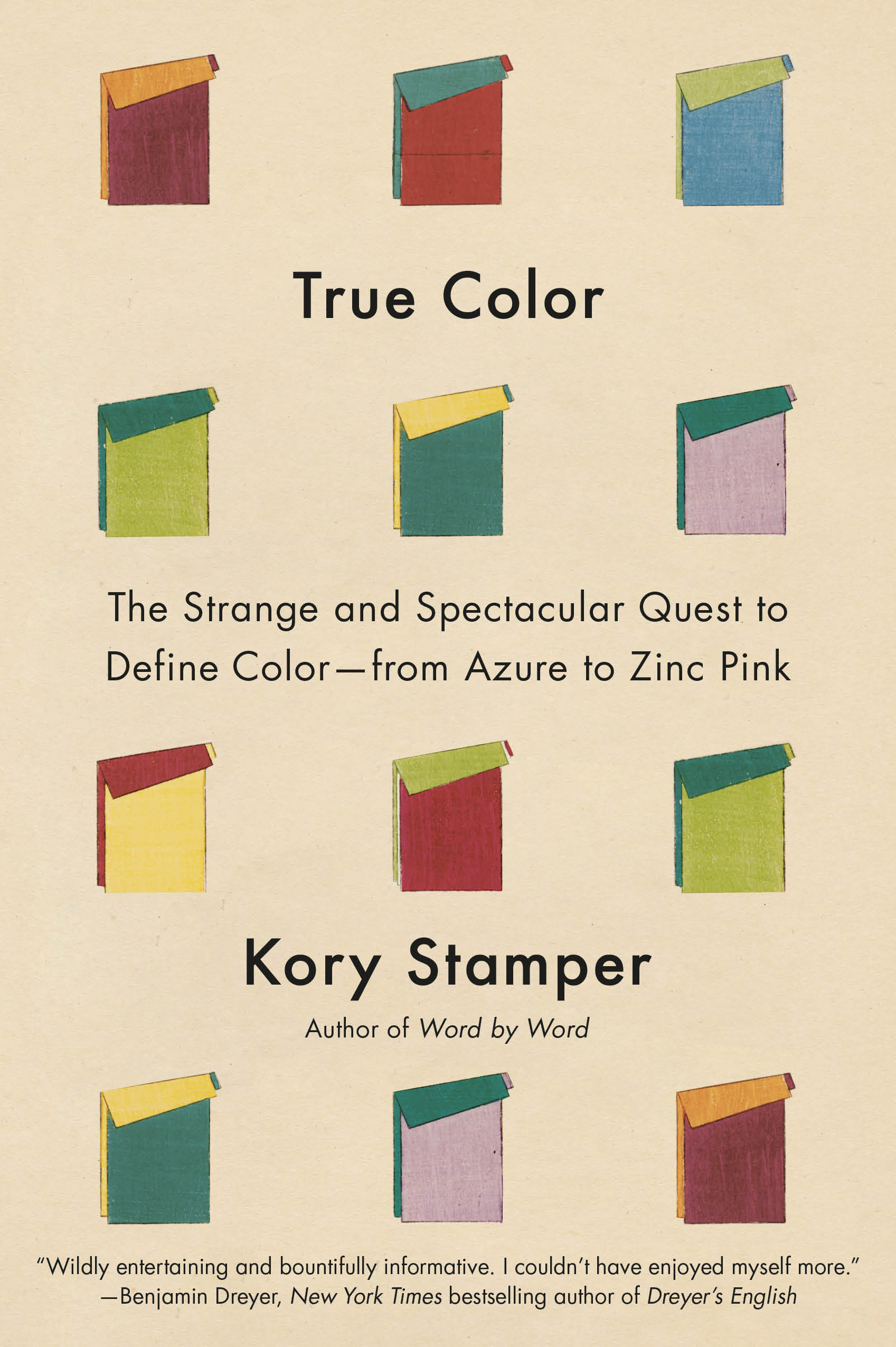
True Color is a different book than Word by Word—less essay, more story, 14 years in the making—but written in my smart-assed, over-researched, footnote-laden style.2 But it is, more importantly, the project that kept me tethered to words and brought me back to myself as a writer, lexicographer, and general goofus what loves and wants to yak about this stupid language, despite the mountain of horseshit that still generally abounds.
You can have it in your hot little hands on March 31, 2026, and you can read an excerpt on Longreads right this very goddamned second.
What’s next? More writing, obvi–for another book, yes, but also here. It took a while to unhook my writing self from my dictionary self; though the dictionary employee is gone, the lexicographer, with her big mouth and opinions, remains. There are important things to say about language, about communication, about motherfucking whimsy.
And, truth be told, I’ve missed this little self-manufactured corner of the internet. Writing is a solitary activity, but even when I’m alone in my office banging out some blah-bitty-blah, I find I’m writing to you, that person who found this dumb blog back in the Paleozoic era, when webrings ruled the earth, and kept reading. I’ve missed this thing we have. I’ve missed you.


 kory stamper
Leave a comment